Chris Orcutt’s Barbaric Yawp
“I sound my barbaric yawp over the roofs of the world.”—Walt Whitman, Leaves of Grass

Photo by Jen Cray
THE OTHER DAY, I wrote that I was going to “take it easy” when it came to self-promotion, but you know what? Screw that.
I don’t want to take it easy. I don’t want to be modest, humble, or self-deprecating. I’ve done that all my life, and I’m sick of it. I was raised by honest and hardworking Mainers—parents and grandparents—who imbued in me the sense that a person shouldn’t brag or go on about himself. Promoting yourself, they suggested, was unseemly.
But as a 20-year professional writer of journalism, video scripts, magazine articles, technical manuals, speeches and a ton of unpublished (and some published) fiction, I’ve learned a few things, and one of the things I’ve learned is that there are a lot of lesser writers out there doing very well for themselves, and do you know why?
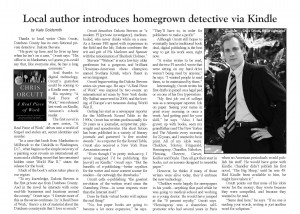
A recent newspaper article by Kate Goldsmith of the N. Dutchess News about me and “A Real Piece of Work.”
That’s right—because they promoted themselves. Because they talked about their work at every turn and made no apologies. Because they didn’t wait around for outside approval of their work or of their status as writers. Because they declared themselves writers and forced the world to consider them as such.
As a kid, I moved too many times; an average of once a year until I was 18. Consequently, wherever I was living, I didn’t want to make waves. I just wanted to get along. Even in the town where I graduated from high school, although I threw some legendary parties there, I was hardly known as Mr. Popular or Mr. Self-Promoter.
The sad fact of it is, I’ve spent the last 20 years playing down myself and my accomplishments, and I don’t want to do it anymore.
Recently the pain of continuous rejection of my work by mainstream publications brought me precipitously close to taking my own life. Beyond that, I found myself consistently thinking that I wouldn’t mind if I were hit by a bus or struck by a falling tree limb. Ultimately I wanted to die, but I didn’t want to take responsibility for the act.
Since then, I’ve gotten on some new medications that are working wonders. Say what you will about the pharmaceutical industry, but as a guy with a potentially paralyzing mental illness, I can declare with authority that some of what they produce actually works and is doing some good in the world.
In my case, they’ve cleared up my thinking, made me 5x more productive, and inspired me to speak up for myself and my work—with confidence—for the first time in my life.
So allow me, if you will, to “sound my barbaric yawp[s] over the roofs of the world,” to “celebrate myself,” as Walt Whitman also put it—to share some of my accomplishments and to declare myself to the universe as a unique creation, never before seen or to be seen again when I shuffle off this mortal coil:
I am a very good writer, and I believe I have the capacity to become a great one. My idols, the writers to whose level I aspire, are the best of the best: Chekhov, Tolstoy, Fitzgerald, Hemingway, White, Cain, Chandler, Cheever, Carver, Nabokov, Keillor and Boyle.
I have written millions of words. Millions. First as a philosophy student, then as a newspaper reporter and freelance writer. Later as a technical writer and speechwriter. Recently as a playwright. And forever as a storyteller. In published and unpublished novels and stories, not to mention 20 years of journal writing, I conservatively estimate I’ve written 5 million words.
In the past 18 months, I have written 25 stories and at least a dozen humorous sketches, all of which have been rejected (so far) by mainstream publications. Of these works, by my excruciatingly high standards I would say a dozen are very good and 6–8 are great pieces of work. I’m not giving up on any of them, but especially not the great ones. I’m confident that some editor out there is going to “get” them and want to publish the work. I’m confident that before I die I will write one solid collection of short stories, and I’m also confident that if I continue to write my very best, I might, just might, pen one perfect short story—one “The Lady with the Dog.”
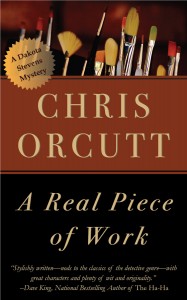
You have to admit, you admire my brazenness and consistency.
I have written 2 exceptional mystery/PI novels—A Real Piece of Work and The Rich Are Different—that I believe have the potential to become modern classics in the genre. They are as well-written and well-told stories as any being published by mainstream publishers today. And I have drafts and outlines of 4 more. One book, you got dick; three, four, five books, you got yourself a series.
I am not a writer who can be pigeonholed, even if, for years, I kept trying to do it to myself. I can do it all—and well—and I refuse to make apologies for it anymore.
I am proud that I have learned to write almost entirely on my own—by writing daily and reading deeply about the subject.
I write every day, and have written every day—at least a page—for 20 years. It’s how I process the world. The world doesn’t make sense to me until I write it down. Writing gives me clarity, and I try to give back to the world some of the clarity it gives me.
Screw taking it easy.
I sound my barbaric yawp over the roofs of the world.

Comments (1)