My Favorite Books: Nabokov’s LOLITA
 Whenever I’m in the middle of rereading it, the novel Lolita casts such a spell on me that I often forget I have it on my person.
Given its subject matter (a pedophile pining away for a pre-pubescent girl), this isn’t a very good idea. Given its subject matter, the book should have a plain brown paper wrapper for a cover. However, like I said, the prose entrances me so much that I tend to forget I’m carrying it.
Like the two times I was interviewing for teaching jobs—first, 12 years ago, at a high school in Freeport, Maine, then six years ago at a college in Manhattan. I must be lucky because both times the first people to notice the book were Vladimir Nabokov fans, exclaiming what a great book Lolita is and nodding approvingly at me, as if to say, “Anybody who appreciates well-crafted sentences by a Russian master of the English language, about a sick man with a (literal) hard-on for little girls, is all right by me—yes, sir!”
(By the way, the pronunciation of “Nabokov”—Nuh-BO-kov or NAB-uh-kov—depends on two things: 1. the superciliousness of the speaker and 2. the weather. Addendum, 12/9/2013: The correct pronunciation of his last name is to be found in his book Strong Opinions, in which he clearly states that it’s Nuh-BOK-ov.)
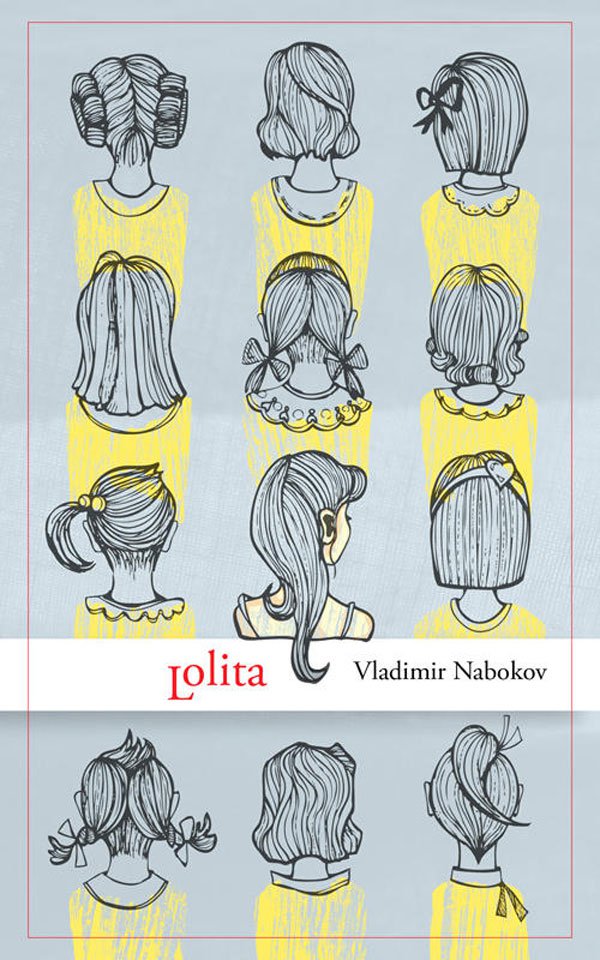
Yesterday afternoon, a neighbor called to tell me that an old friend of mine, a Catholic priest, was visiting in town and giving the Mass that night. So I went. However, as I opened the church doors I noticed that my paperback copy of Lolita was sticking out of my jacket pocket. And to make matters worse, this edition has a particularly racy picture on the cover: a girl licking an orange Popsicle. (The novel has inspired a wide assortment of cover art.)
 I was holding it in my hands, wondering what to do with it, remarking to myself that the blonde trollop on the cover looked nothing like the nymphet heroine, Miss Dolores Haze (Lolita, Lola, Lo), when I heard footsteps coming up the walkway. Voices were approaching from inside. There was no time. I couldn’t leave the novel in my pocket without the risk of at least the title glaring out to the world in hot pink—LOLITA—so I did the next best thing. I shoved it down my pants.
An old couple shuffled up the stairs as I held the door open for them. “Why, thank you, young man!” the woman chirped.
They beamed at me, apparently unaware that their benefactor was concealing a genius but profane piece of literature down his pants. You never know who you’re dealing with. Which, ironically, is pretty much the story of Humbert Humbert, the sad sack protagonist of Lolita.
I sat and stood and kneeled my way through the Mass, concerned with every movement that the book would slide down my pant leg at any moment, and I was especially nervous when, at the end, my priest friend greeted me at the exit. But lo (pun intended) and behold, the worst never happened. The object of my would-be ignominy was wedged snugly between my pubis bone and the band of my Calvin Klein boxer shorts. (“Nothing gets between me and my Calvins! That is, except a well-worn copy of Lo-Lee-Ta.”)
I emerged from the church unscathed.
 Lest you think I love this novel solely for the memorable situations it has put me in over the years, allow me to talk about the writing, because as far as I’m concerned, were it not for the genius-dripping sentences on EVERY page, this would just be another so-so, semi-smutty novel.
As I’ve mentioned before, I keep a notebook of great writing examples, and my favorite lines from Lolita take up several pages. However, it’s not the sexual lines that fascinate me. In fact, when you get right down to it, there’s very little “sex” in Lolita at all. (In one of the book’s first reviews, the British novelist Kingsley Amis remarked, “Where’s all the sex, then?”)
In the 53 years since its publication, some initially disappointed readers have come to understand that what really makes the novel a masterpiece, what makes it so compellingly original and re-readable, has very little to do with sex. Yes, Nabokov does a great job of using sexual tension to develop and maintain narrative drive, but it’s really the masterful use of two other writing elements that make Lolita so damn hypnotic:
1. Voice
2. Language (diction, sentence variety and imagery)
 The fact is, whether you like the subject matter or not, if you have half a brain, you can’t keep yourself from putting down the novel every few sentences and shaking your head in awe. It doesn’t matter what the narrator, Humbert Humbert, is talking about; the precision, artistry and seductive quality of his storytelling will keep you interested regardless of what’s happening plot-wise.
Here, then, are just a few of the sentences that have left me with my metaphorical tongue hanging out. The effect of any of Nabokov’s best sentences on me is not unlike witnessing a stunning woman (or man, depending on your orientation) do something completely unselfconscious, like smile in the sun or hold open a door for someone. Nabokov did a lot of his writing on notecards with a #2 pencil, and his elegant craftsmanship shows itself in every sentence:
The dimmest of my pollutive dreams was a thousand times more dazzling than all the adultery the most virile writer of genius or the most talented impotent might imagine.
Another time a red-haired school girl hung over me in the metro and a revelation of axillary russet I obtained remained in my blood for weeks.
A little further, the Haze house, a white-frame horror, appeared, looking dingy and old, more gray than white—the kind of place you know will have a rubber tube affixable to the tub faucet in lieu of a shower.
Presently, the lady herself—sandals, maroon slacks, yellow silk blouse, squarish face, in that order—came down the steps, her index finger still tapping upon her cigarette.
Heat ripple still with us; a most favonian week.
So I just grunted and stretched my limbs nonconcominantly (le mot juste) and presently went up to my room.
Her adorable profile, parted lips, warm hair were some three inches from my bared eyetooth; and I felt the heat of her limbs through her rough tomboy clothes. All at once I knew I could kiss her throat or the wick of her mouth with perfect impunity.
For God’s sake, even the man’s sentence fragments are exquisite:
…with the monkeyish nimbleness that was so typical of that American nymphet…
…and that first impression (a very narrow human interval between two tiger heartbeats) carried the clear implication…
…the tragic eyes of unsuccessful blondes…
 Lolita was so successful that it eclipsed all of Nabokov’s other work, a fact that Playboy magazine confronted him with in a 1964 interview. What’s interesting about this snippet (taken from the very beginning of the interview) is the curiosity with which the author seems to have viewed his own writing. There’s a degree of distance and self-examination here that you don’t see in many other great writers (as much as I love his work, Hemingway comes to mind). Not to mention Nabokov’s incredibly thoughtful and eloquent answer.
Playboy: With the American publication of Lolita in 1958, your fame and fortune mushroomed almost overnight from high repute among the literary cognoscenti—which you bad enjoyed for more than 30 years—to both acclaim and abuse as the world-renowned author of a sensational bestseller. In the aftermath of this cause celebre, do you ever regret having written Lolita?
Nabokov: On the contrary, I shudder retrospectively when I recall that there was a moment, in 1950, and again in 1951, when I was on the point of burning Humbert Humbert’s little black diary. No, I shall never regret Lolita. She was like the composition of a beautiful puzzle—its composition and its solution at the same time, since one is a mirror view of the other, depending on the way you look. Of course she completely eclipsed my other works—at least those I wrote in English: The Real Life of Sebastian Knight, Bend Sinister, my short stories, my book of recollections; but I cannot grudge her this. There is a queer, tender charm about that nymphet.
Now, over 50 years later, while the debate about the relative “disgustingness” of Humbert Humbert’s pedophilia rages on, Nabokov’s son is about to release the author’s final, unfinished novel—a work that the master on his deathbed requested be burned.
The book, The Original of Laura, is due for publication next year, and it’s said to contain “all the sex” left out of Lolita. I’ll be lining up to buy it, but not for the sex, and not for the memorable situations I might find myself in with the book. I’ll be buying it for all of the other stuff that motivated me to write over 2,000 words here on one of my favorite books:
Lolita, light of my life, fire of my loins. My sin, my soul. Lo-lee-ta: the tip of the tongue taking a trip of three steps down the palate to tap, at three, on the teeth. Lo. Lee. Ta.

Comments (4)