The Inspiration of New Places and New Spaces for a Novelist
For a novelist, sometimes a minuscule change in routine, place or living situation can produce a massive shift in perspective that opens the floodgates of creativity. Having moved over 40 times in my 49 years, I’ve experienced this phenomenon often in my writing life.
In June 2010, having been back in my high school town of Millbrook, NY for three years, I moved to an apartment a mile outside of the village and received a massive dose of inspiration. One Hundred Miles from Manhattan was born on a balmy June evening, when I heard, wafting on a soft breeze through the open window, the panicked moos of cows and the yips of coyotes. Wondering if I was hallucinating, I sat up in bed, faced the window and cupped my hands around my ears.

“What is it?” Alexas asked me in the darkness.
“Screaming cows,” I said. “And coyotes. I think the coyotes are going after the calves.”
“Oh, that’s awful!” she said.
“Yeah, sad,” I said, getting back under the covers, “but from a creative standpoint, it’s pure gold. There’s a story there. I’m seeing a trophy wife who’s tired of doing bullshit committees and riding lessons and shtupping one of the townies…maybe she learns how to hunt and becomes a coyote vigilante.”
“Oooh, I like it,” Alexas said.
“Good. I’ll start writing it in the morning.”
And I did, beginning a story entitled “The Mighty Huntress,” about Caprice Highgate’s metamorphosis from trophy wife to hunter and independent woman. Revised many times, that story eventually formed the first chapter of One Hundred Miles.
In the weeks that followed, I wrote in the mornings, and during my afternoon walks or bike rides into the village and around the outskirts, I began to notice other details about the countryside that I either hadn’t noticed previously, or had but only peripherally. There were two shooting clubs within a couple miles of my apartment, and echoing from those places every day were shotgun blasts—sometimes so rapid and staccato that the shooting sounded like Civil War skirmishes.
Another detail: houses in the area that had lain abandoned all through my childhood in Millbrook were now restored and invariably occupied by ambitious nouveau-riche Manhattanites. A couple times a year, there were “horse trials”—show jumping (dressage) and cross-country obstacle courses. These were events that I had never bothered to investigate when I lived in the village proper. I made a point of attending several of these events and taking copious notes, notes that formed the final chapter of One Hundred Miles, the love story of a Manhattan book editor and a wealthy equestrienne named Titania Hammersley (by the way, I got her surname from a street I frequently passed on the Poughkeepsie Arterial).

Moving a mile outside of the village gave me just enough distance from the place and the people that I began to notice, or hear about, things that had escaped my attention when I was a fixture in town: for example, there was a Millbrook area swingers club. (I still can’t believe it.) There were ongoing dramas involving a certain young couple in town—a hairdresser and a waiter at the diner—and the townspeople typically chose sides. The antediluvian Thorne and Bennett College buildings had officially become eyesores. And finally, a certain contractor’s pickup truck regularly drove into a variety of Millbrook estates, estates where the wives reputedly were alone during the workweek; and since these women’s houses couldn’t all have leaky faucets, there must be another reason for the contractor going there.
As I continued to write, I noticed that certain characters that were “stars” or narrators of some stories reappeared in other ones. I also noticed that what I was really writing was a novel, the central character of which was the place itself: a fictionalized version of Millbrook—Wellington, NY.

There’s a lot of my own direct experience in One Hundred Miles from Manhattan, including the scene where the town doctor, Dr. Hale, attends a lecture by a spiritual guru; that was based on a program I attended in New York City by the late Dr. Wayne Dyer. One of the characters with his own chapter (I’ll leave you to discover which one it is) is based on me and the hijinks that ensued when we moved out of the village in the summer of 2010.
At readings and book signings I’ve been asked the following question by prospective readers of the novel (almost always women, by the way, who ask the question with an uplifted eyebrow): “Is Wellington actually Millbrook?” Of course what they’re really asking is whether what occurs between the covers of the novel actually happened, and, if so, whether they might know some of the “characters.” I usually give my most charming, enigmatic smile—half rogue, half naughty little boy—and say, “Well, Wellington is inspired by Millbrook.”

“ ‘Inspired by’?” the woman says with a frown. “What’s that mean?”
“Well, the characters and situations are pretty universal,” I say. “Every wealthy town has conflicts between townies and hilltoppers. Every wealthy town has contractors who service lonely trophy wives. Every wealthy town has bored rich people who dress up like English lords and shoot pheasants, or ride horses and wear their riding boots everywhere to advertise they’re equestrians. Those characters exist everywhere. So, if what you’re asking me is, ‘Did the things in this book really happen?’ then I’d say, yes, they really did—just not exactly like that, with those names, etc.”
Thoroughly confused at this point, the prospective reader usually grabs a copy, asks me to sign it, and hurries away to the cash register—eager to start reading or to simply get the hell away from me.
Before One Hundred Miles from Manhattan, I never would have believed that moving as little as a mile away could so radically shift my perspective and heighten my sensitivity to the place where I lived, but it did, and the proof is in the pages of the novel.
* * *
I wrote the preceding section of this blog entry in the spring of 2018, back when I was creating content for my social media publicist to publicize. But when I read it over, I decided to wait to publish the piece until I moved again.
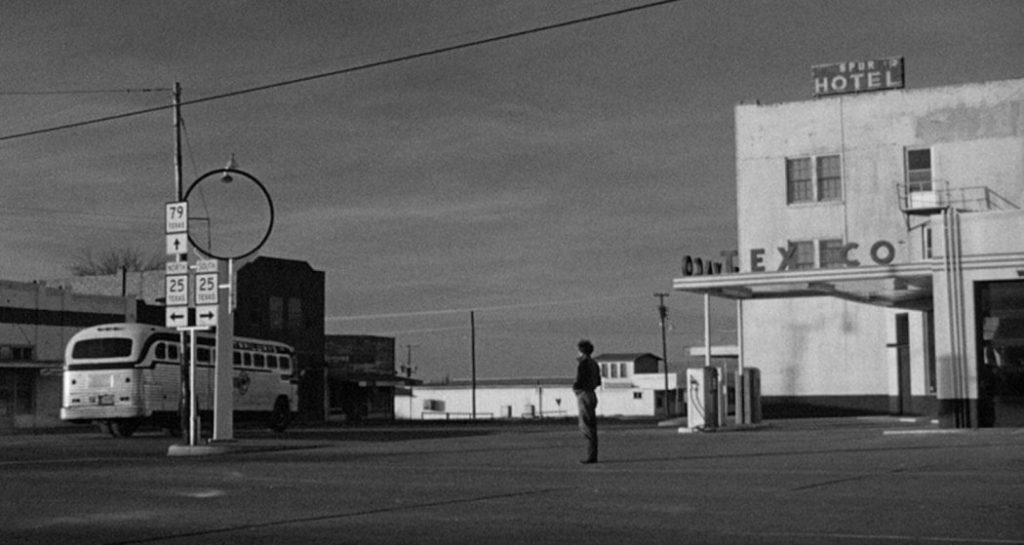
In the 13 years that have passed since I returned to Millbrook, the community has changed so much that it now bears absolutely no resemblance to the small town where I graduated from high school. Thirty-two years ago, Millbrook was a lot like the one-stoplight small town in the movie The Last Picture Show; today it’s largely a bastion of wealthy, pretentious Manhattan weekenders and Westchester county transplants, whose sole contributions to the community seem to be increased property values and taxes, a plethora of Pilates and “hot yoga” studios, increased prices at the diner and Marona’s market, a profusion of Tesla automobiles, and (the one positive) a superfluity of young women in jodhpurs and chestnut riding boots. Seeing my hometown decline from a humble country village with an Agway feed store to a Philistine cesspool whose entire economy is built on real estate, antiques and “gentleman farms” was too much for me to bear, so I decided to move away. (But don’t worry…I’m putting all of these negative feelings about the changed Millbrook into my next Dakota mystery.)
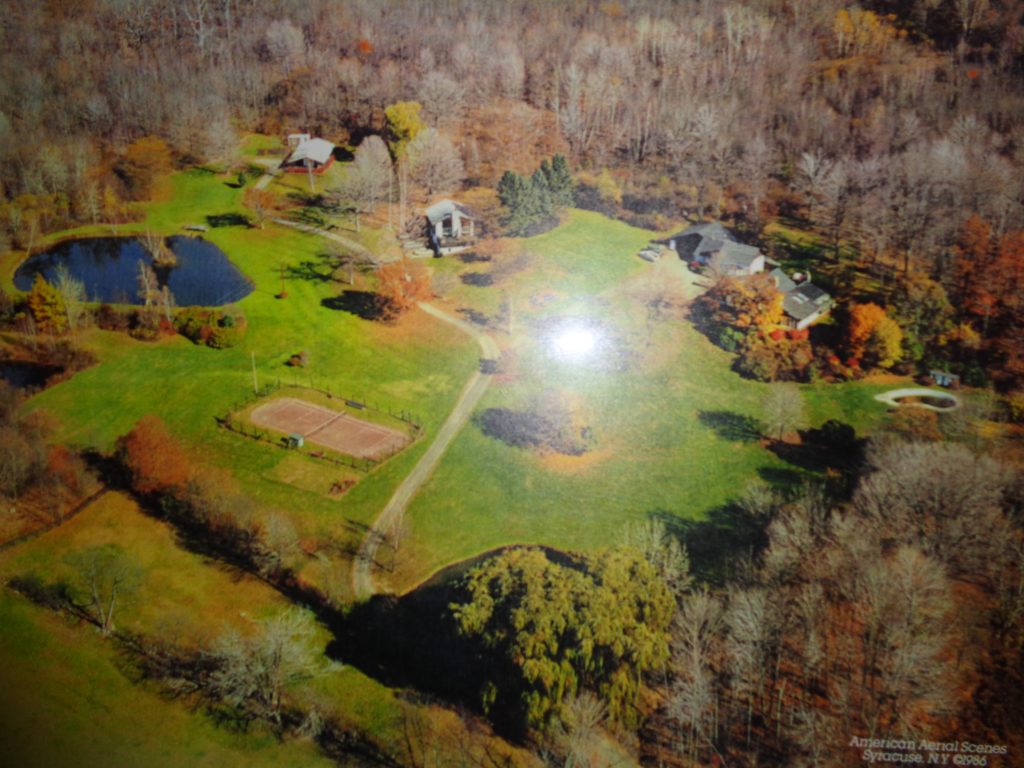
As I wrote at the beginning of this entry, I’ve moved a lot. As a kid, I moved more often than most “military brats.” The longest I lived in one community was between the ages of 13 and 16, and the closest I ever had to “a home” in my life was my grandparents’ estate in Union Vale (south of Millbrook). During all of my childhood moves, until I graduated from high school, the only “home” in my life, the only permanent place with stable people that I could depend on, was my grandparents’ place in the Clove Valley—with its swimming pool, tennis court, trout and bass ponds, acres and acres of woods, and a horse farm next door. And for over 30 years since then—the entirety of my professional writing life—by necessity I’ve been nomadic.
Or, if I was relatively stable at the time—that is, I wasn’t changing apartments every year—I had to shoehorn my writing life into less-than-ideal spaces and living situations. This has led to Alexas and me living in apartments above or beneath hoarders, mentally disturbed people or recently paroled ex-cons; next door to not one but two firehouses; over garages and pawnshops, you name it. (True story: In 1998, we were living in an apartment above a pawnshop in Portland, Maine when, one afternoon out of nowhere, said pawnshop was raided by the FBI.) With all of these distractions in close proximity to where I’ve lived, in order to get the quiet and solitude I’ve needed to write I’ve had to find it ad hoc in libraries, parks and cafés.

Fortunately Alexas and I are members of the Vassar College community. For the past 13 years I’ve been able to work in Vassar’s Thompson Memorial Library virtually unmolested. I say “virtually unmolested” because, every so often, in their overzealousness the Security and/or Buildings & Grounds staff at the college go on a tear testing fire alarms or banging on shit that doesn’t seem to need fixing. Then there were the many, many times that, despite writing in a study carrel in the most remote corner of the library basement (in the Government Docs room), one passive-aggressive, OCD woman made a point of passing my workspace during her twice-daily walk around the building’s basement perimeter, even though she had no reason to be there; I solved that problem by setting up a tidy Les Miserables barricade of chairs in the aisle each morning, forcing her to change her route. Hey, crazy lady, if you’re reading this, SUUUUUUCCKK IIIIIIIITTTT!
Even so, 90 percent of the time the Vassar library has been a great place to write, and I know it’s been a great place to write because of how productive I’ve been. In the past decade, I wrote, revised and published nine books there, and (counting the 600,000-word Big Book) I’ve written the first drafts of eleven more books.
That’s 20 books total in ten years. Not bad.
However, as productive as I’ve been in my writing life over the past decade, in order to find the increasingly elusive quiet and solitude I’ve needed to write, I’ve had to spend an awful lot of my time schlepping around. And this schlepping has been complicated by having to do it with multiple bags: my work bag, which contains my computer and/or Alphasmart Neo to type on; journals; notepads; pencils; pens, dictionary; thesaurus; medical/hygiene stuff (like a toothbrush & aspirin); keys; iPod; snacks; wallet; my lunch bag, which contains coolers, Thermoses, cups and utensils; and some kind of gym bag, which contains at a minimum a clean towel and a change of underwear. Then, at the end of the day, when Alexas and I drove home, I had to schlep all of those bags back into the house, along with any groceries and other household purchases. The bottom line is, I have spent my entire adult life schlepping crap.
For a long time I’ve wanted to get out of the schlepping business, and to that end, Alexas and I spent the last 18 months hunting for a house. (Since I’m considering writing a book about our real estate travails, I won’t go into detail about them here.) I have a lot of thoughts about the real estate industry in New York, but suffice it to say, until the laws in New York change or until Zillow or another online company disrupts the market by cutting agents out of the process, we want nothing to do with buying property in New York.
For over 20 years of marriage, Alexas and I have lived in one-bathroom, <600 square-foot apartments. And because we wanted to live below our means and maintain a small carbon footprint, we only ever allowed ourselves one car. We consistently sacrificed convenience and comfort in order to live simply. But we reached a point where we didn’t want to sacrifice anymore. When searching for a house, we wanted, à la The Jeffersons on the 70s TV show, to “move on up.” We wanted, in a word, sanctuary. Sanctuary from neighbors and the increasingly complicated, hectic outside world.
Well, we searched for our sanctuary for over a year and a half and couldn’t find it. Or, in the three cases where we found it and put in very fair offers, we were prevented from getting it by unscrupulous real estate agents, greedy or delusional sellers, or Manhattan/Westchester douches looking to snag inexpensive weekend/vacation properties.
I might sound bitter about this experience, but honestly I’m not. I’m grateful for what we learned about ourselves, each other, and what’s really important to us. More than anything, it’s the lost time that bothers me.
Time that I could have been working more intensely on my books.
Time that I can never get back.
However…deep-down I know this is for the best. Since quitting the house hunt in October, we found a terrific, recently remodeled townhouse apartment with three times the space. The apartment gives us almost all of the conveniences we were looking for in a house, without the hassles of owning a place and having to interact with the New York real estate market. I’ll have a larger, dedicated office in which to write; we’ll each have a bathroom; we can get a dog (I’ve missed having a companion during the day since Sweetie shuffled off this mortal coil); and we’ll have a large workout space. The bottom line is, we don’t need to own something to get the sanctuary we’ve been seeking.
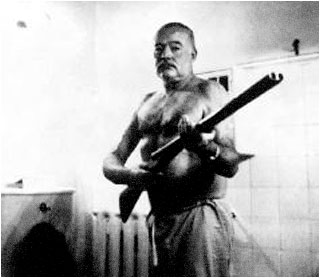
Throughout this 18-month ordeal, I was reminded of a number of ideas espoused by some of my writer/artist heroes regarding property ownership. Henry David Thoreau’s maxim that you don’t own your possessions; your possessions own you. Painter Andrew Wyeth’s statement to his wife Betsy, who, when they were flush with cash in the 1980s, started buying up real estate; Wyeth said to her, “I don’t have to own something to love it.” And, loudest of all in my head, Ernest Hemingway’s admonition to writers to never develop what he called “an establishment”—an expensive house with a big monthly nut, people on a payroll, etc.
With the new apartment, I’ll be getting most of the sanctuary—the writing space and quiet I’ve needed and craved—without the headaches of ownership or maintaining an establishment, and I believe it’s going to bust things wide-open for me with my writing.
If I can produce the equivalent of 20 books in a decade, writing and revising millions of words while working largely out of a knapsack in a college library basement, what will I be capable of when I no longer have to cram all of my writing projects into tight spaces? How much high-quality work will I be able to produce if I no longer have to spend hours every day schlepping—to the library, to the gym, to the store? In short, I’m excited to see what I’ll be able to accomplish when there are no longer these limits of time and space on my work.
For example, just having a spacious office where all of my books-in progress are always accessible is going to make me inestimably more productive. Currently I have nine books in progress: the Big Book, which is actually the word-length equivalent of 5 long novels; a journal about writing the Big Book; a Biblical novella; a new Dakota novel (that will likely be a big two-part novel); and a nascent franchise—a “male romance” thriller series.
Soon I will have the ultimate workspace for my writing—a workspace that I’ve only ever dreamed of. For decades I told myself that I didn’t need such a space or that I didn’t want it, piously declaring that to a true writer where he writes is immaterial, and that if my working conditions were too comfortable, too pristine, I might not get any work done. I told myself that I needed the chaos from neighbors, leaf-blowers, raucous music and lack of space—that these things gave me the creative tension that fueled my writing. I told myself that I didn’t want a window with a nice view because it would distract me and I wouldn’t get any work done. I told myself I didn’t want a large writing space because it was unnecessary; I only wrote one book at a time, one sentence at a time. I told myself that I didn’t mind having my manuscripts and materials crammed into boxes and cubby-holes. I told myself I didn’t need a quiet spot for just reading and writing. I told myself that, compared to people living in developing nations, I was living like a king, so I had no right to complain or to want my working conditions to be better.
You know what? To hell with all of that.
By the end of 2019, when I anticipate having my office and library fully set up, organized and decorated, Chris Orcutt, novelist, will be back and better than ever.
Better…stronger…faster.
Again: If I can produce the equivalent of 20 books in a decade, writing and revising millions of words while working largely out of a knapsack in a college library basement, what will I be capable of with the ideal office space and increased time?
I have a feeling I’m going to be dangerous.
* * *
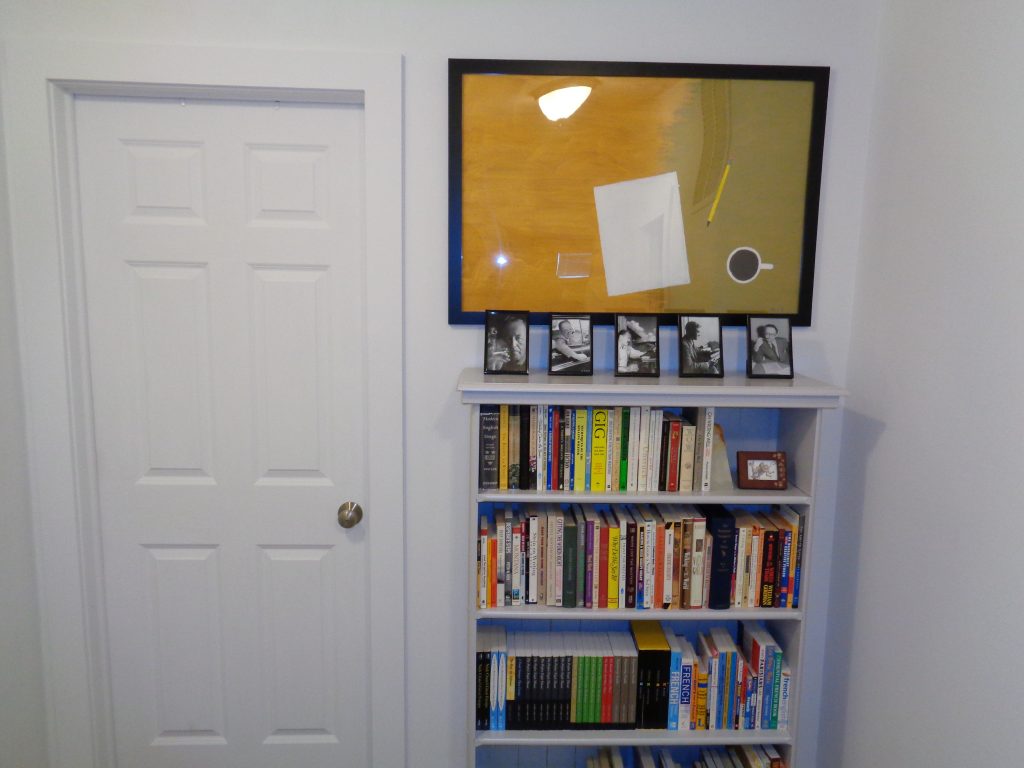



Epilogue: It’s Saturday, January 4, 2020. Alexas and I moved in on December 16. After spending over a month non-stop planning, packing, unpacking and setting up, as of today we are 100% finished. We cleaned up and partially finished the entire basement, installed an air purifier and black rubber tile flooring, and set up our old HD TV and sound system down there so we can have a workout room with “cardio cinema.” The kitchen is set up exactly to my liking, with new little conveniences that I’ve always wanted, and all of my coffee-making accoutrements on one counter. All of our books (well over 2,000) are unpacked and shelved.
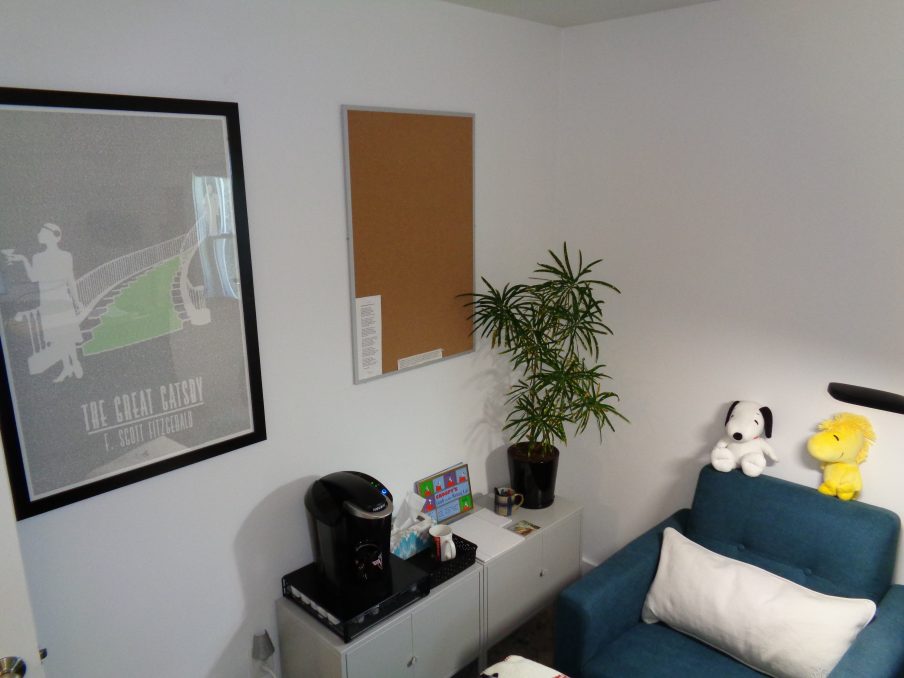
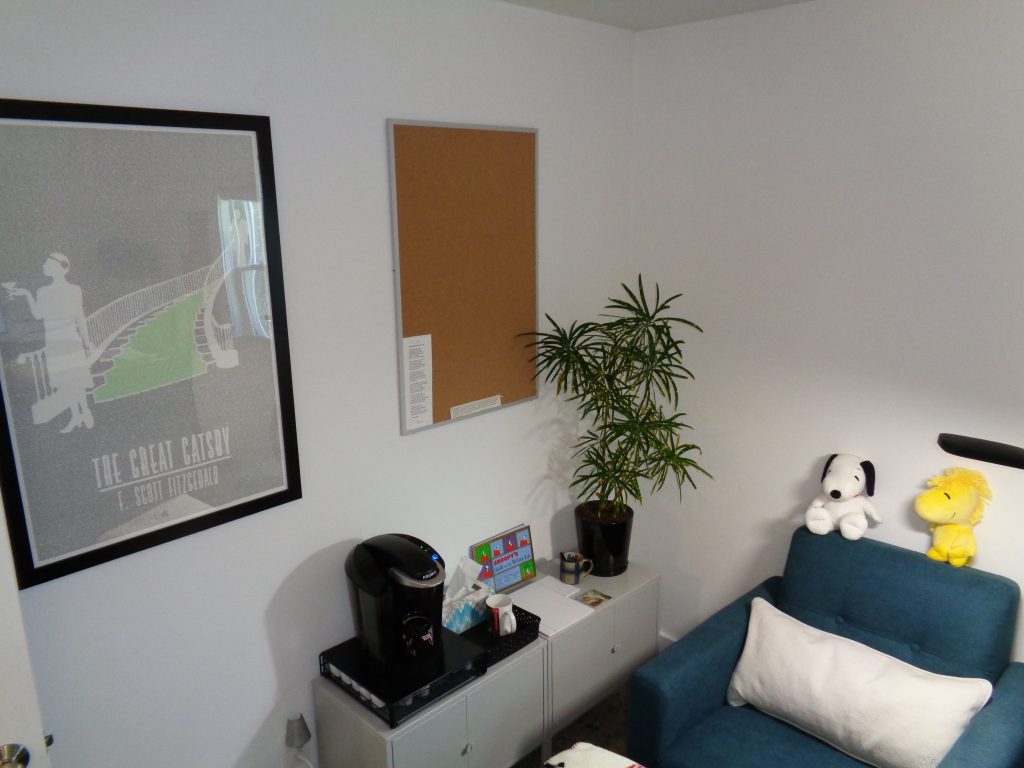
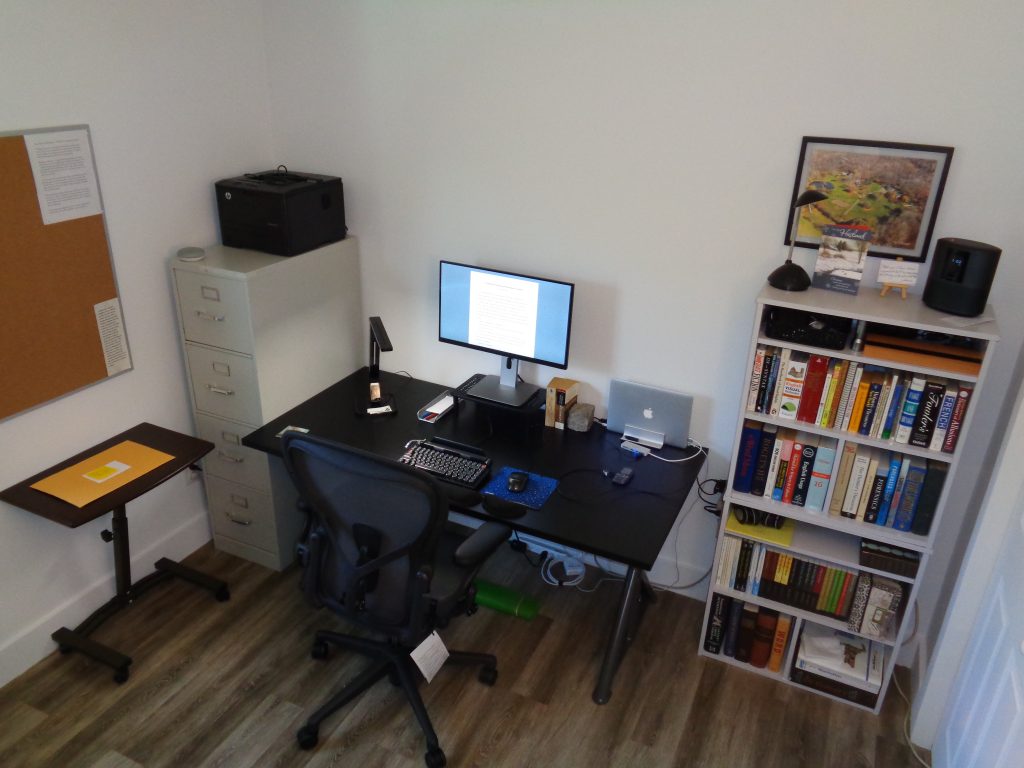
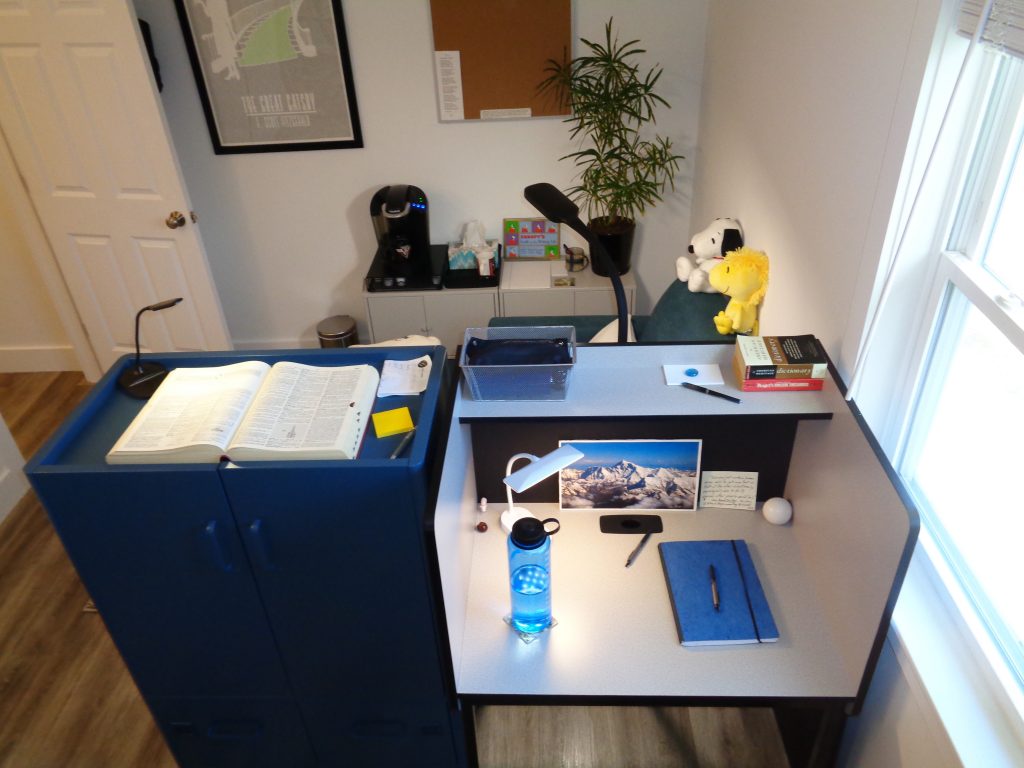
As for my office, it is—for me—utterly perfect. I still need to hang more artwork on the walls, but Alexas made setting up my office her first priority, so I have my reading/editing area with a comfortable armchair and a great LED task light, right beside my very own Keurig coffee maker (writer: “a machine that converts caffeine into words”). On the other side of the room, I have my long-desired study carrel for doing focused writing, a cabinet to hold all my works in progress, and a big, sleek, uncluttered desk for doing computer work.

I’ve never been much for gadgets (especially for their own sake), but I now have a Google Home Mini on one side of my desk and a Bose speaker with Amazon’s Alexa on the other side. I’ve had the Bose with Alexa for almost two years. Notwithstanding the humorous hijinks that ensue when your voice assistant is named Alexa and your wife is named Alexas (I ask Alexas where something is, and Alexa replies, “Sorry, I don’t know how to do that”; I ask Alexa to play blizzard sounds at bedtime and a dozing, panic-stricken Alexas beside me replies, “Blizzard? There’s a blizzard outside?!”), given that I purposely don’t have internet access during the work day (too distracting) both of these tools have proven very useful when it comes to getting answers to niggling research questions while I’m writing.
Finally, I want to note that my new office was designed by my brilliant, multitalented wife, who spent hours on online floor planner programs to devise the perfect layout. She also organized my supply closet—not only fitting my ridiculous quantity of office supplies into the space, but also making all of them accessible, and giving me a standing workspace in the closet as well.
I know it’s a cliché to say so, but I don’t care: I am blessed. Right now I have no problems in my life and I can focus entirely on my books. I have a lot of work to do. In the next ten years I want to put out at least another dozen books.
This is Chris Orcutt, signing off and getting back to writing.

Comments (0)