Writing in Asian Restaurants
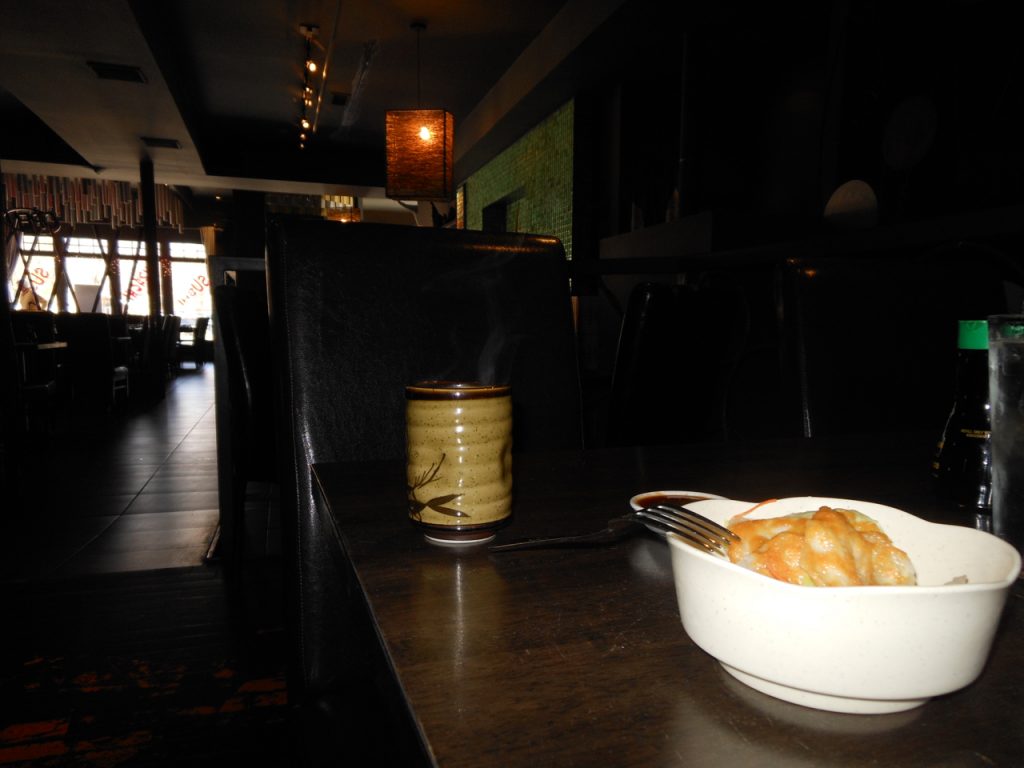 I’m writing this blog entry in one of my favorite Asian restaurants: Momiji in Rhinebeck, NY.
I’m not exactly sure why, but I’ve been writing in Asian restaurants for over 25 years. Maybe it’s that when Chinese or Japanese waitresses get talking in their native tongues, their voices take on a soothing quality, surrounding me like exotic bird calls in the Amazon. Maybe it’s the décor with its fabric scrolls of Chinese or Japanese lettering, which makes me forever curious about what’s printed there. Or maybe it’s because in every Asian restaurant I’ve written in, no one working there has ever questioned what I was doing. They just let me order and eat my food, and sit there and write almost indefinitely.
The first Asian restaurant I wrote in was the now-defunct Yenching Palace on Boylston Street in Boston. I was a sophomore in college, and the Yenching Palace was right around the corner from a professor-friend’s apartment. They served the best Szechuan dishes I’ve ever had; I think the original owner was from the Szechuan Province. All through college, about once a week, I would go there for lunch or dinner alone and write—sometimes stories, but more often philosophy papers.
A few years after college, while living in Maine, I wrote occasionally at Panda Garden in Bangor, Maine, and frequently fantasized about bumping into another Panda Garden regular and fellow writer, Stephen King.
(I did eventually bump into him years later, in the South Portland Mall parking lot. I made Alexas stop the car, and I ran over and shook his hand and introduced myself. I remember telling him that I thought his novella Rita Hayworth and Shawshank Redemption was his best work, and he said, “Well, that’s a new one. You’re the first person to tell me that.” I didn’t tell him I was a writer, too; I was sure he was inundated with so-called writers asking him to read their dog-eared manuscripts. We shook hands and he, rather briskly as I recall, ducked into his Jaguar XJS—it might have been silver, but I think it was green—and sped away.)
At a Portland, Maine Chinese restaurant—which served the best crab Rangoon I’ve ever had, by the way—I wrote some of my first novel, Nick Chase’s Great Escape. I wrote that book in that restaurant, the now-gone Portland Diner, and in my seventh period study hall at Freeport High School.
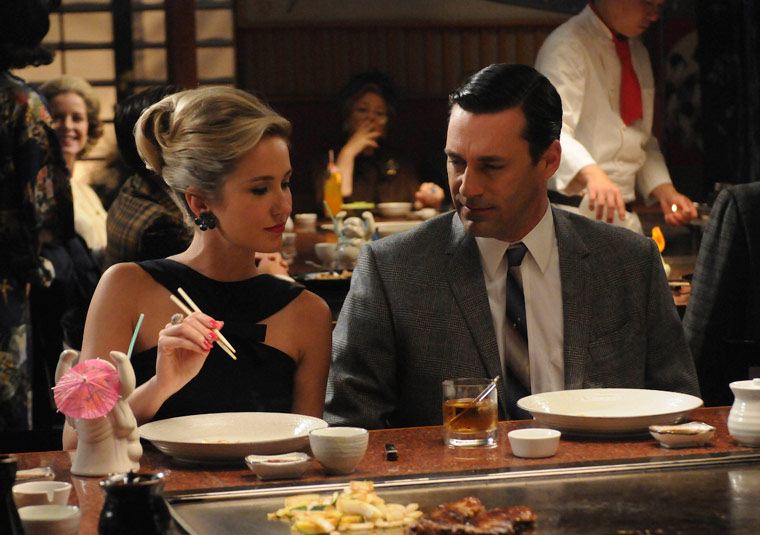
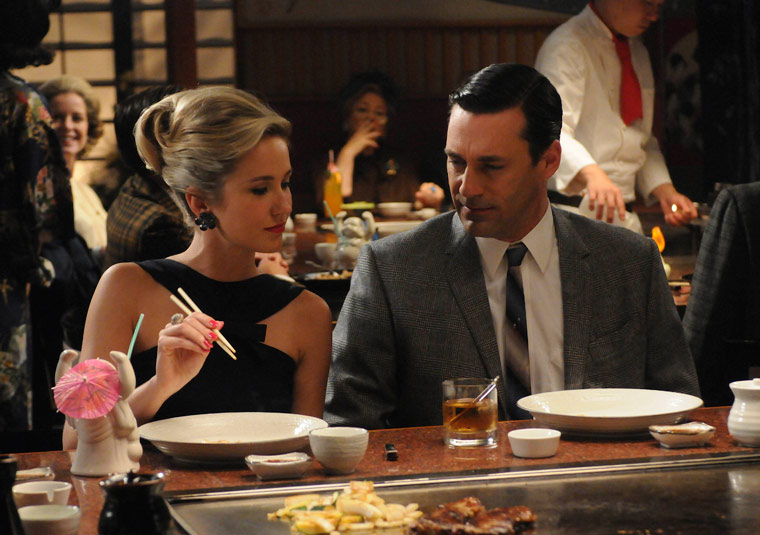
The author’s fantasy doppelgänger, Don Draper, at Benihana.
Soon after Alexas and I were married, we moved to New York, and that’s when I developed a love affair with the original Japanese hibachi restaurant, Benihana, at 47 West 56th Street.
Inside the original foyer were scads of photographs of owner/founder Rocky Aoki with celebrities—movie stars, journalists, comics, heads of state, singers, and even a few novelists. I fantasized about being up there one day, a scribbled autograph across a photo of Rocky and me that read, “To Rocky: Thanks for all the good times and the great food, pal! –Chris.”
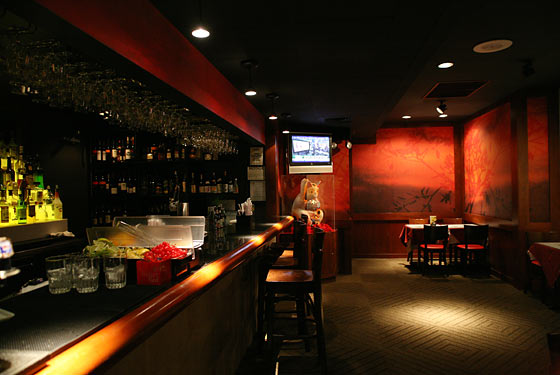
The bar at Behihana, W. 56th St., NY, NY.
Alas, Rocky passed away before I ever had a chance to make his acquaintance, much less appear in a photo with him, but when I began writing the Dakota Stevens mysteries, I gave Dakota two of my loves: redheads and Benihana, and I actually wrote the Benihana scene with Dakota and Svetlana that appears in A Real Piece of Work at the bar in Benihana, after which I sat down at one of the big hibachi tables and had a delectable hibachi seafood combination: shrimp, scallops and lobster.
While visiting Alexas’s parents in San Francisco, they took us to a famous Chinese restaurant in Chinatown for dim sum, and I snuck away to the bar to write a couple pages of The Rich Are Different.

The author in a kung fu gi his wife got for him in Hong Kong 20 years ago.
The China–Tokyo restaurant in Millbrook, NY has the distinction of being the only Asian restaurant I’ve written in during two different periods of my life. The first time was in 1992, right after college, when I got my first job as a reporter for the Millbrook Round Table, and one of my first news stories was a highly favorable review of the then-brand new China–Tokyo restaurant. From that point forward, at least once a week at lunch, I ate for free and wrote in a booth in the private party room, getting up occasionally to refill my tea cup from the big urn outside the kitchen doors.
Fourteen years later, in 2006, I returned to Millbrook and the owner, Katie, pointed out my now-yellowing framed review on the wall. Since I lived in the village then, less than a football field away from the restaurant, I wrote there a couple days a week for a few years. Eventually, however, Alexas and I moved outside of the village so I could have more peace and quiet for my writing.
But I continued my tradition of writing in Asian restaurants, and since then I’ve found four more that suit me: Isamu in Beacon, NY (the best Singapore rice noodle in the area); Chan’s Peking on Raymond Avenue in Poughkeepsie (excellent shrimp rolls); and Formosa on Main Street, Poughkeepsie (I always order their Kung Pao Shrimp).
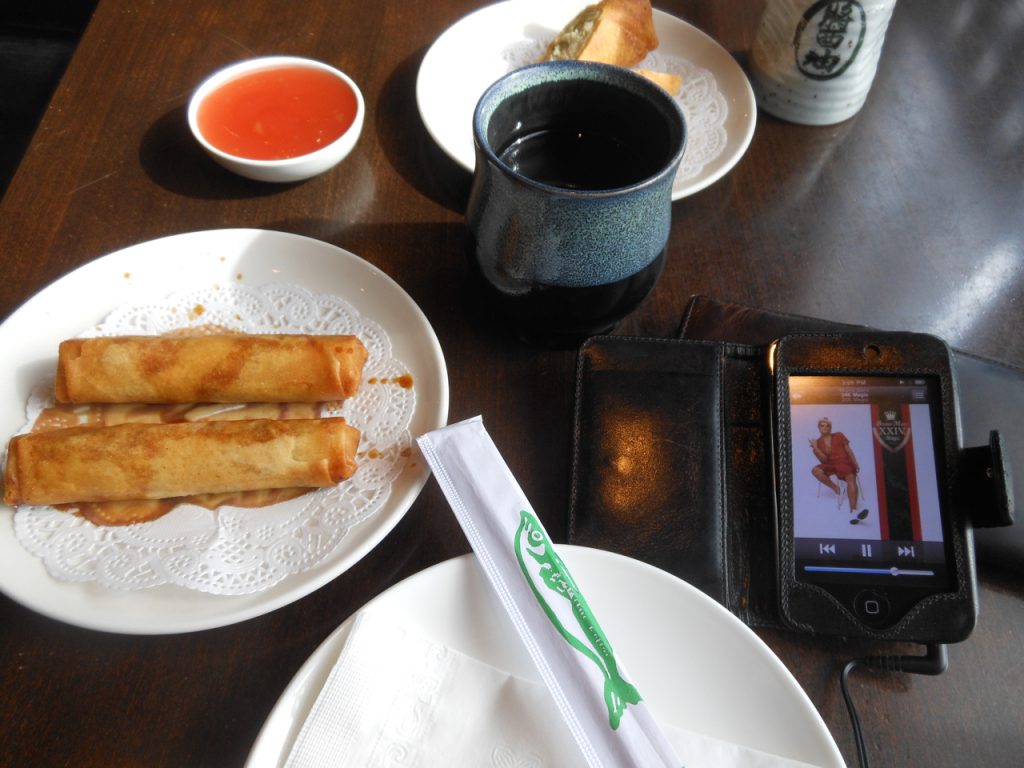 One afternoon in Formosa, while eating and writing in the back room (I’m the only customer they allow back there, by the way, so suck it), one of the waitresses, Kay, said, “I see you on Amazon China the other day.”
“Excuse me?” I said.
“Amazon China,” she said, her face blooming into a smile. “I see your picture and your books.”
“What?! Really?”
“Yes. I show you!”
She whipped out her smart phone and, like all millennial girls, proceeded to manipulate it with dizzying speed. She showed me a screen with my author photo and the covers of my eight books lined up.
“See?!” she said.
All of the text was in Chinese characters, so I had no idea what it said.
“What’s it say?” I asked. “Read it to me, would you, Kay?”
She did, and sure enough, it was just my author page text. I thought of the fact that China had a population of over a billion, and if just one one-thousandth of them (a million people) bought my book, I’d be a rich man.
“Mistah Orcutt,” she said demurely. She put her phone away and adjusted her eyeglasses. “You’re…you’re famous!”
I wasn’t, of course, but seeing how much Kay was enjoying knowing a “famous person,” I kept my mouth shut.
“You’re a doll, Kay,” I said.
She looked confused.
“It means you’re very sweet,” I added.
After that, Kay mentioned that she liked to read English (although she wasn’t very good at it yet), so I gave her and her co-worker, Crystal, signed copies of One Hundred Miles from Manhattan and The Perfect Triple Threat.
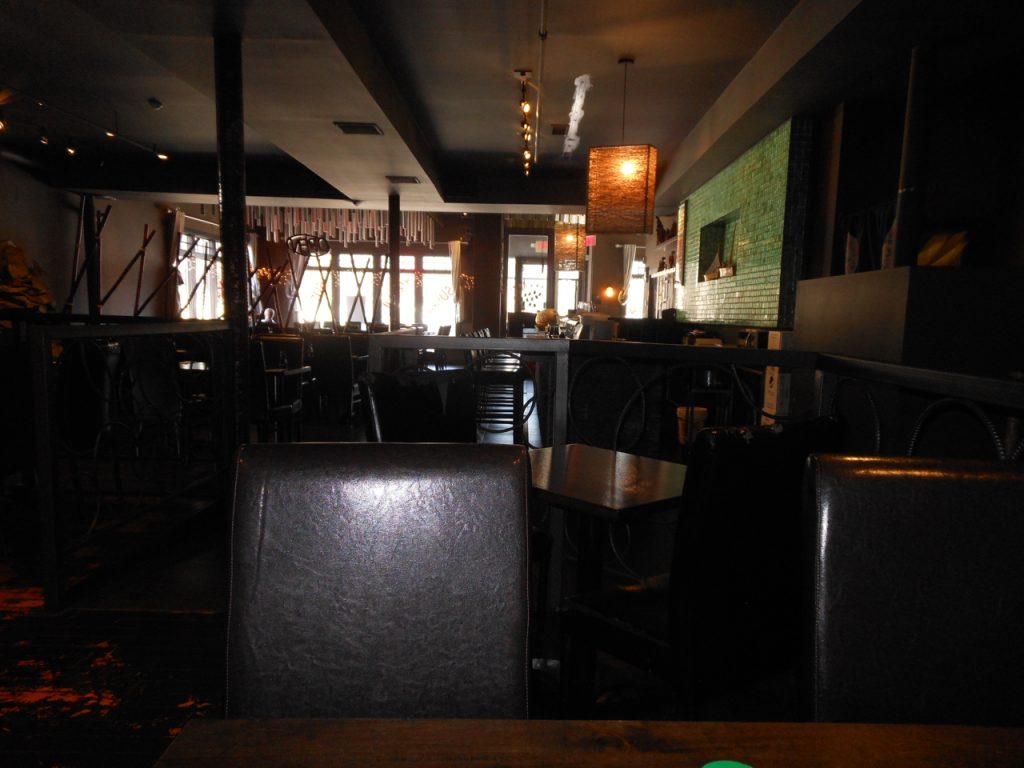 My favorite Asian restaurant to write in, however, is Momiji in Rhinebeck, NY. I’ve been coming here for over a decade, and I’ve gotten the same dish so many times that the owners, the waitresses, and the cooks know exactly what I want from the second I walk in the door: hibachi shrimp with fried rice (no egg) instead of noodles, green salad instead of miso soup, water with lemon, and hot tea. The only deviation I’ve ever made from this order has been scallops instead of shrimp.
When I walk in, I nod and greet the manager, Monica, in Mandarin: “Knee-HOW. Knee-HOW-mah? Hello. How are you?” We exchange a few other pleasantries and she waves me to the back of the restaurant, where I take my table: on an elevated seating area, with my back to the wall and a clear view of the front door.
My father, and my friends Jason and Tony, have met me here for lunch occasionally. Tony, who came on a bright, scorching day in July, said of seeing me in the dim recesses of the restaurant, “It’s like going to see a bookie. But a bookie who’s writing a novel. You’re all set up back there, writing, sometimes working the phone.”
“Maybe I should start taking book,” I said wistfully.
Tony, who grew up in Brooklyn and knew a number of these characters, rolled his eyes.
“Yeah, great idea,” he said.
Of all the Asian restaurants I’ve written in, Momiji has been the most inspiring, and I’ve been more productive here than in any other. Just today, in two hours I’ve written 2,000 words—this blog entry and half of another. Over the past decade, here in Momiji I’ve written from scratch, or edited, portions of all eight of my books.
No one accosts me. No one knows who the hell I am. No one cares. It’s beautiful.
Maybe there will come a day when I’ll be as famous a writer as Stephen King, and I’ll have to deal with fans glancing at me from across the restaurant and whispering to each other in hushed tones and tentatively approaching me, but I hope not. I hope my Asian restaurants continue to be sanctuaries for me, quiet places for me to enjoy a meal and write for a few hours.

Comments (0)