
Chris Orcutt is an acclaimed American novelist with 35 years of professional writing experience. He is the author of the Bodaciously True & Totally Awesome coming-of-age epic and the Dakota Stevens Mystery Series. Beyond novels and short stories, Chris has written journalism, scripts, plays, and speeches.
The Books
Since 2015, Chris Orcutt been working exclusively on his magnum opus. Bodaciously True & Totally Awesome: The Legendary Adventures of Avery “Ace” Craig is a 9-episode novel about teens in the 1980s. It’s about ’80s teens, but for adults (in other words, it’s decidedly not YA literature), and he’s applied this epic storytelling approach to the least examined, most misunderstood, most marginalized narrative space in American literature: the lives and inner worlds of teenagers.
The 9 episodes or books of Bodaciously tell the story of Avery and his high school friends against the vibrant backdrop of the Reagan era with seminal events including the return of Halley’s Comet, the Challenger explosion, the Chernobyl accident, the Reykjavik conference, the “Garbage Barge” fiasco, and President Reagan’s Berlin Wall speech. Over the course of two years, Avery goes on adventures across the United States and to Europe; interacts with a variety of ’80s celebrities and political leaders; navigates the perilous, tempestuous seas of sex and romance; learns the nature of true love; endures death, loss, and hardship; and transforms from a teenage boy into a young man.
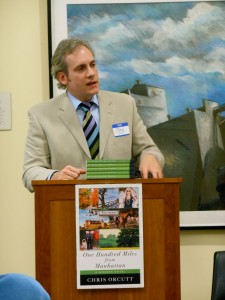 Like other groundbreaking novels, Orcutt’s new work transcends existing labels. It’s a coming-of-age story, a love story, historical fiction, and an odyssey, offering readers a truly immersive experience: immersion in the music, culture, fashion, lingo, customs, and everyday details of teenage life in the ’80s. Truly, what he’s offering readers is a time machine back to this magical era—possibly the greatest time ever to be a teenager in America.
In order to create this time machine for readers, for over a decade Orcutt wrote and lived in the 1980s as much as possible. With virtually no contact with the internet or current events, Orcutt immersed himself in the music, TV shows, movies, and culture from 1985-87. Indeed, one 1980s cultural historian has dubbed him “Lord of the ’80s” because of how deeply immersed in ’80s culture he was during the decade of writing his magnum opus, and the wide-ranging knowledge he developed about 1980s music, TV, movies, fashion, and cultural and historical events. The result is that Orcutt has created a new genre in American literature—what he’s calling an “episodic novel” and “teen epic.”
“Regardless of whether it’s a commercial or critical success,” Orcutt says, “the work is undeniably monumental , and it required a unique combination of gifts to write, including facility with language, yes, but also persistence, stamina, self-discipline, and self-direction. I know that Bodaciously is my magnum opus, and I know I was born to write it.
 “To people who haven’t embarked on something that the rest of the world considers impossible, what I’m about to say is going to sound immodest or outright arrogant, but here it is: I consider the writing of Bodaciously—a 1.2-million-word, 9-episode novel—to be a literary accomplishment on par with summiting Mount Everest,” Orcutt says. “However, because I wrote, edited, typeset, proofread, and polished every draft on my own, I consider what I’ve done analogous to mountaineer Reinhold Messner’s climbing of Everest in 1980—when he did it solo, without bottled oxygen, and without a support team.”
Throughout the decade of writing Bodaciously, three quotes on his office whiteboard have kept him motivated:
“It always seems impossible until it’s done.”
— Nelson Mandela
“You can’t train for something all your life and then have it fall short because you are hurrying to get it finished.”
— John Steinbeck
“There are just certain human beings able to put one foot in front of the other relentlessly, psychologically able to do it, whereas other people would fail.”
— from the Mt. Everest documentary Beyond the Edge
Orcutt’s earlier fiction, including Dakota Stevens Mystery Series; One Hundred Miles from Manhattan; The Man, The Myth, The Legend; and Perpetuating Trouble, has received critical acclaim from a variety of professional reviewers: Publishers Weekly, Midwest Book Review, and Kirkus Reviews, among others.
The Bio
 Born in the State of Maine, Orcutt lived the majority of his childhood and early adulthood in Dutchess County, New York. He attended college in Boston, Massachusetts, graduating summa cum laude, Phi Beta Kappa with a degree in philosophy. Orcutt’s first job after college was for the now-defunct Taconic Newspapers (including The Millbrook Round Table, where he was awarded by the New York Press Association), and later on writing as a freelance reporter for The Poughkeepsie Journal (New York’s oldest newspaper) and as a freelancer for magazines. Through his 20s into his early 30s, after journalism and before becoming a full-time novelist, Orcutt earned his living as a high school American Studies teacher, corporate communications executive, college writing instructor, and speechwriter.
The Process
Throughout his career, Orcutt has written with one guiding principle: “I write books that I would want to read,” he says. “When I’m reading a novel, I’m always looking for surprises—the plot twist, the beautiful scene, the quirky character, the memorable line of dialogue, or the gorgeous, picturesque sentence. So those are the things I want to give to my readers.”
Like a samurai sword-maker who forges, folds, and hammers a length of steel until it becomes both a perfect weapon and a piece of art, Chris Orcutt invests thousands of hours in every one of his novels—writing, researching, rewriting, and editing—to make them the very best they can be.

An old-school novelist who writes his first drafts with a Palomino Blackwing 602 pencil or one of his many vintage typewriters, Orcutt believes in hard work over talent, substance over hype—rising every day at 4 or 5 a.m., making coffee, and pressing on with his latest work in progress. If you are a young or aspiring writer, you have come to the right place. Based on his wide-ranging writing experience, Orcutt has written a number of pieces on his blog about the writing process—including hints, tips, and instruction. These blog entries have been curated on his Thoughts on Writing page.
Orcutt’s favorite writers (in alphabetical order) are Jane Austen, Bill Bryson, Raymond Carver, Raymond Chandler, John Cheever, Anton Chekhov, F. Scott Fitzgerald, Ian Fleming, Charles Frazier, Ernest Hemingway, Henrik Ibsen, John Irving, David Mamet, Vladimir Nabokov, Robert B. Parker, William Shakespeare, John Steinbeck, Leo Tolstoy, and E.B. White. His goal as a writer is lofty, but one that keeps him motivated:
 “There are lots of good writers out there, but I hold myself and my work to a higher standard. I want to become a great writer. I want to summit Mount Everest as a writer and stand up there with Tolstoy, Chekhov, Nabokov, Hemingway, and Fitzgerald. And I’m going to make it up there, or, like George Mallory on Everest, die trying.”
For more on Orcutt, check out this extensive interview with WorldClassPerformer.com.
—
Subscribe and receive news and exclusive content:
