
Spark Joy: In Which a Novelist Applies the Ideas of KonMari to His Entire Life
 Inspired by my organizing genius wife, I recently watched the program Tidying Up with Japanese organization guru Marie Kondo. In the program and in her books (The Life-Changing Magic of Tidying Up and Spark Joy), Kondo explains the necessity of keeping in our lives only those objects that “spark joy” for us. If an object does not spark joy for us, Kondo says, we need to thank it for its time with us and let it go. Kondo’s methodology is called KonMari, and it’s not new. Organizing experts like my wife have understood this idea for years.
Anyone who knows my wife knows that she is incredibly organized. Her work office perpetually looks like she was just hired or fired. Since we’ve been married, although we’ve only ever lived in small apartments, my wife has been a master at eliminating clutter and developing systems to keep our things contained, accessible and efficient. It’s one of the many things about her I’ve come to really admire.
This past weekend, my wife and I “KonMari-ed” our entire apartment. Following Marie Kondo’s methodology, we began with clothing, then our books (a library of 1,500+ volumes), then papers, then komono (basically everything else in the house), and finally sentimental items. When we were finished, having only kept those items that spark joy for us and reorganized them, I felt a deep sense of calm and peace.
 Besides watching Marie Kondo’s TV program, I’ve been reading a Kondo parody entitled The Life Changing Magic of Not Giving a F*ck, as well as a book about the new Japanese Minimalism entitled Goodbye, Things—in which the author argues for only having in your life those objects you absolutely need. Admittedly, this idea is a bit too extreme for me. Do I really need my original Barry Manilow and Billy Joel LPs? No, but I enjoy them.
For now I’m sticking with Kondo’s “spark joy” principle and have decided to apply the principle to all aspects of my life: not only physical things, but also the people and relationships in my life; businesses, institutions, restaurants and stores I interact with; and perceived obligations from outside entities. I decided that from now on, whenever I’m considering an interaction, I’m going to ask myself, “Based on my previous experiences, will this interaction bring joy into my life, or will it only create a new experience of annoyance, frustration, anger and/or sadness?”
Ten days ago, I had an opportunity to put the “spark joy” principle into action. I went to a Poughkeepsie, NY post office with three boxes of inscribed copies of my books. In the past, I had always been able to get the Media Mail rate (less than ½ of the Priority Mail rate) without an issue, because the boxes contained only books. The boxes I attempted to ship on Friday also contained only books, and they were addressed to libraries. For these reasons, I thought my boxes would beyond reproach.
However, despite having used Media Mail for dozens of shipments in the past, this time I was informed that my boxes had been flagged for possible inspection. Why? Because, the clerk said, people often tried to send non-media items with the Media Mail rate. I pointed out to her that these boxes were addressed to libraries; what else could I possibly be shipping to libraries other than books or media? When this didn’t convince her, I told her to open the box and inspect it right there in front of me. She told me she couldn’t, that only “someone higher up” was allowed to inspect the boxes.
 So I left with my packages, because I wasn’t willing to have some faceless entity maybe open my boxes at some undetermined date and maybe approve them. I left, but not before giving them a long-overdue, festering rant about how it’s precisely this kind of nonsense that is inexorably putting the USPS out of business. I stated (emphatically, but without shouting) that I have been a regular USPS customer for over 20 years, spending hundreds or thousands of dollars a year, but no more; from now on, I won’t be buying so much as a stamp from them. I will never again pay the USPS for anything. I added that the USPS losing loyal customers like me is their death knell. For a long time they’ve operated under the delusion that they’re the only game in town, but they’re not; “There’s this new thing out,” I said, glaring at the postal workers. “It’s called the Internet.” Finally, as I held the door open, letting the frigid February air gust in, I said to the two employees behind the counter, “I hope you’re saving for retirement, because I give the USPS five more years. In five years, you’ll either be out of business entirely, or the USPS will be a fraction of the business it once was.”
And by the glimmer of fearful recognition that shone in the postal workers’ eyes when they heard my prediction, I know I’m right.
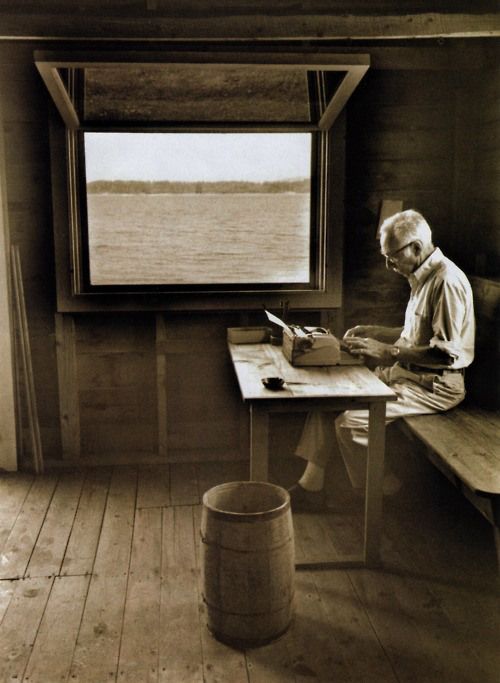
E.B. White, writing in his barn office overlooking the Maine coast.
(By the way, if you think my prediction of the USPS going out of business within five years is ridiculous, then you don’t know your history. My model for this prediction is the history of the railroad in the US. After WWII, all rail service—passenger and freight—declined precipitously because of the rise of faster, more convenient alternatives: personal automobiles, the US Interstate system, and long-haul trucking. Well, the USPS is like the railroad of yesteryear, and other shipping companies and the Internet are like those faster, more convenient alternatives. Writing in his 1960 essay “The Railroad,” E.B. White unequivocally describes the precipitous decline of the railroad after the war and presages its eventual near-extinction. And with the speed of information and change today, I contend that the decline of the USPS is going to be even more rapid; five years is surely too long; it will probably be utterly gone within three years.)
So we now come to the main idea of this blog entry—choosing things that “spark joy” over ones that make me want to brandish an axe. When I left the U.S. Postal “Service” that morning, I took my packages to United Parcel Service (UPS). Yes, I paid about twice what USPS would have charged me with their Media Mail rate, but the excellent, serene experience I had with UPS made the extra cost worthwhile.
Instead of being grilled about the contents of my boxes or informed that my boxes might be inspected by some nameless, faceless entity; instead of getting backtalk from surly, passive-aggressive employees, I got the following from the UPS clerk: “Yes, sir. No, sir. Absolutely, sir. Here is your tracking number, sir. Thank you for your business, sir. Have a great day, sir!” Seriously, the young man must have called me “sir” about eight times in two minutes. It was a pleasant experience—the kind of experience I hadn’t had with the USPS in a very long time, if ever.
Applying Marie Kondo’s “spark joy” principle to this situation, it’s as if USPS was like an old sweater in my closet, a sweater which, per her ritual, I took out, laid on my bed, and asked myself, “Should I keep this in my life? Does it spark joy for me?” The answer was, “Hell no.” The sweater was old and torn, had inexplicable stains on it, and didn’t fit me anymore. In retrospect I see why I’d kept the sweater around: because I’d purchased it a long time ago—back when it was shiny and new and it did fit me. I had come to associate that old sweater with some ancient positive experiences I’d had wearing it, forgetting that since then all of my experiences with it had been the sartorial equivalent of tarring and feathering.
In contrast, when I took out my UPS sweater, I had a great experience. UPS truly “sparked joy” for me, so I’m keeping that sweater and tossing the U.S. Postal “Service” one.
As I thought about this in the days following, I realized that I’ve been “KonMari-ing” my life for 20 years without being consciously aware of it. Since 2002, when I quit my day job with Merrill Lynch, I have applied—often without conscious thought—these ideas of eliminating clutter and distractions in my work life. There is a long list of things I don’t do, people I don’t spend time with, activities I no longer engage in, and “obligations” I no longer honor.
For example, over the past two years I’ve dramatically decreased my involvement with social media, to the point that I now only go on the internet once a week, and that only to check my email. I glance at my Facebook account even less—maybe every three weeks—just to make sure people haven’t died or tried to contact me with important opportunities.
Guess what? Invariably, they haven’t done either.
A part of me would love to pull out of social media and the online world altogether, but having totaled up the amount of time I’ve “invested” in my online presence, I know that over the course of a decade I put a work-year into that crap. To simply delete all of my accounts would effectively be throwing away a year of my life. I’m better off just leaving the pages and links and SEO junk out there like Old West storefront shingles, weather-beaten and creaking in the dusty wind. At least then I might eventually gain some positive return on my time investment.
Returning to the KonMari idea—keeping only the things that spark joy for me and dumping the stuff that makes me crazy—I am now applying KonMari to everything in my life. Immediately after last Friday’s imbroglio with the USPS, I started creating lists of people, places, things, restaurants, stores, etc. that give me joy, and lists of those that make me crazy.
 The bottom line is, I’m getting rid of the stuff that makes me crazy, and keeping (and doing more with) those things that give me joy. Here’s another example: three months ago I recognized that alcohol no longer brought me joy (if it ever did). While in a drunken stupor, I punched something or somebody (no idea; I blacked out), and I broke my hand (the 5th metacarpal neck; see picture of X‑ray). When I woke up the next morning, I knew the alcohol was making me crazy and had to go.
I’ve quit drinking for very long periods in the past (as long as 8 years), but there are two differences this time. One, I’m now in Alcoholics Anonymous—going to meetings and “working the program.” Two, I’m applying what I’ve learned about KonMari to the problem. Alcohol equals no joy for me; therefore, alcohol is officially out of my life forever.
This week, I turn 49 years old. Even though health- and fitness-wise I routinely pass for a guy ten years younger, the fact is, chronologically I’m almost 50, which means that I have endured the existential, psychic weight of nearly half a century.
I am now officially “too old for this crap.”
While talking on the phone with a high school friend the other day, apropos of nothing he said, “We are running out of time.” Another friend, over a year ago, told me how when he turned 50, he made the decision not to spend time with people who don’t make him feel good.
Both of these ideas have been ringing in my head since my friends uttered them—especially the point about time:
I am running out of time.
Time to become the best writer I’m capable of becoming. Time to enjoy my life and those people most important to me.

Orcutt, July 2018. On his T‑shirt is his creed as a writer: “It is your object to convey everything to the reader so that he remembers it not as a story he had read but as something that happened to himself.” — Ernest Hemingway
In terms of my writing, I think if I continue to keep myself in great physical shape, I should be able to produce excellent work for another 20–25 years. With this endpoint in mind, however, it’s imperative that I continue to KonMari my life.
If I only have another 20 years to become the best writer I can become, I’ll be damned if I’m going to willingly give a second of it to anything or anybody who doesn’t give me joy in return.
It’s taken me decades of focus and saying “no” to lots of things, but I’ve managed to hone my life to a razor’s edge. I’ve raised to an art form the elimination of distractions and things that will prevent me from becoming the best writer I can become. Because I draw great inspiration—dare I say joy?—from a disciplined, routine, Sisyphean life that would make most other people want to put their head in an unlit gas oven and breathe deeply, I will continue to do whatever I must to protect that life.

Comments (0)